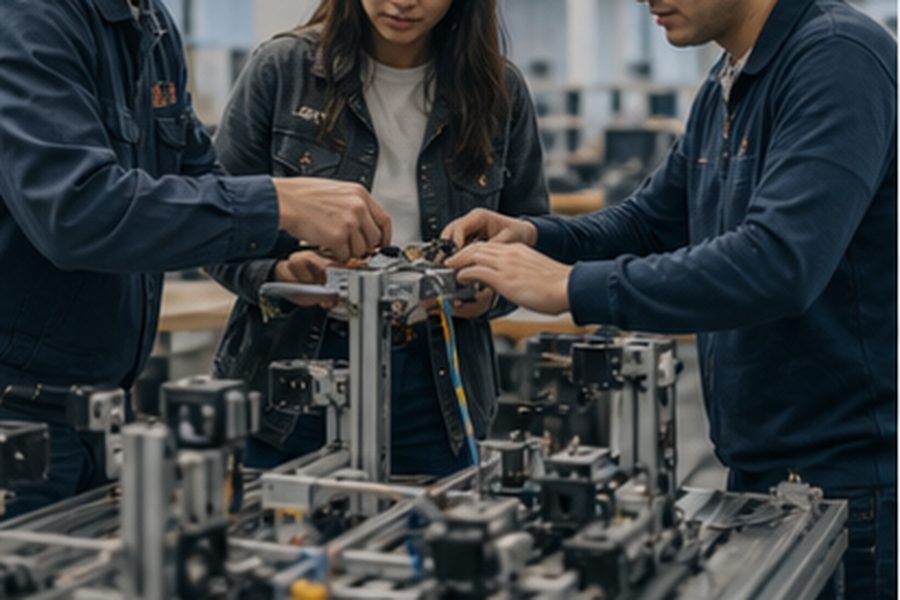
A growing number of mid-size manufacturers are turning to modular, pop-up production lines as a way to test new products without committing to expensive fixed assets. This approach, which borrows from the lean startup methodology of rapid iteration, allows companies to validate demand, refine processes, and scale only when market signals are clear.
What Changed
Traditionally, launching a new physical product required a manufacturer to invest in dedicated machinery, floor space, and labour before a single unit was sold. This capital-intensive model created high barriers to entry and significant financial risk if the product failed to gain traction.
In the past three to five years, a combination of factors has made modular production more viable. Advances in digital design and computer numerical control (CNC) machining have reduced the cost of reconfigurable tooling. The rise of contract manufacturing platforms, such as Xometry and Fictiv, has given mid-size firms access to on-demand capacity without owning the equipment. Meanwhile, supply chain disruptions during the pandemic pushed many companies to seek more flexible, localised production options.
Modular factories typically use standardised, movable workstations that can be reconfigured for different products. These workstations are often mounted on casters or pallets, allowing them to be rearranged or relocated quickly. Some systems use plug-and-play electrical and pneumatic connections, so a line can be set up in days rather than months.
Why It Matters
For mid-size manufacturers, the ability to test a product with a pop-up line reduces the financial downside of failure. Instead of spending millions on a dedicated assembly line, a company might invest tens of thousands in a modular setup. If the product fails, the equipment can be repurposed for another project. If it succeeds, the line can be scaled incrementally.

This model also shortens time to market. A modular line can be assembled from existing components, bypassing the long lead times associated with custom machinery. For industries with short product life cycles, such as consumer electronics or fashion accessories, this speed is a competitive advantage.
Who Is Affected
Mid-size manufacturers (typically those with revenue between £10 million and £500 million) are the primary adopters. These firms have the engineering resources to design modular systems but lack the balance sheet to absorb large capital losses from failed product launches.
Contract manufacturers and industrial equipment suppliers are also affected. Companies that offer modular workstations, such as Bosch Rexroth and item Industrietechnik, have seen increased demand for their reconfigurable framing and conveyor systems. Platforms like Xometry and Protolabs benefit from the shift toward on-demand production.
Investors in manufacturing-focused venture capital and private equity are paying attention. A portfolio company that can test products with lower capital risk is arguably a more attractive investment.
Commercial Impact
The commercial impact is most visible in three areas:
- Capital efficiency. A modular line can cost 60-80% less than a dedicated line, according to industry estimates from equipment suppliers. This frees up cash for other investments, such as R&D or marketing.
- Reduced inventory risk. Because production can be started and stopped quickly, manufacturers can operate with lower finished goods inventory. This reduces the cost of unsold stock and the need for warehousing.
- Faster product iteration. A modular line can be reconfigured in hours or days, allowing engineers to test design changes without shutting down production for weeks. This accelerates the learning cycle and can lead to better products.
Risks / Unknowns
Modular production is not a universal solution. It works best for products with relatively simple assembly requirements and moderate volumes. For high-volume, low-mix products, a dedicated line remains more cost-effective.
There are also operational risks. Modular lines may have lower throughput than fixed lines, and the frequent reconfiguration can introduce quality variability. Companies need robust standard operating procedures and training to maintain consistency.
Another unknown is the long-term durability of modular equipment. While suppliers claim their systems are built for repeated reconfiguration, there is limited data on failure rates after several years of use.
Related Intelligence & Strategic Context
For readers tracking cross-sector implications, see our detailed report on multi-generational workforce contract: how mid-market firms are structuring employment terms to retain gen x and gen z simultaneously, alongside the strategic implications of multi-skilled workforce premium: how mid-market firms are restructuring compensation and career ladders to retain employees who operate across engineering, sales, and operations. Broader structural developments are analyzed in our detailed report on cross-border data residency cost curve: how mid-market firms are structuring data storage and processing across multiple jurisdictions to comply with divergent privacy laws without duplicating infrastructure. For jurisdictional frameworks and regional execution, consult commercial entity formation in the US corporate ecosystem, specialist commentary from the Future Business desk.
FY Outlook
The trend toward modular production is likely to accelerate. As digital design tools become more accessible and the cost of automation continues to fall, even smaller manufacturers will be able to adopt pop-up lines. We expect to see more hybrid models, where a company uses a modular line for initial production and then transitions to a dedicated line once demand is proven.
Regulatory changes could also play a role. If governments introduce tax incentives for flexible manufacturing or localised production, the business case for modular factories will strengthen.
Conclusion
The modular factory represents a pragmatic evolution in manufacturing strategy. By decoupling product testing from large capital commitments, mid-size manufacturers can innovate more freely and respond faster to market changes. The approach is not without risks, but for many firms, the trade-off between flexibility and efficiency is increasingly favourable.
Sources and Notes
This analysis draws on publicly available information from industrial equipment suppliers, contract manufacturing platforms, and industry reports. Specific financial figures are illustrative and based on typical ranges cited by suppliers. No proprietary data was used. Readers should verify claims with their own suppliers before making investment decisions.