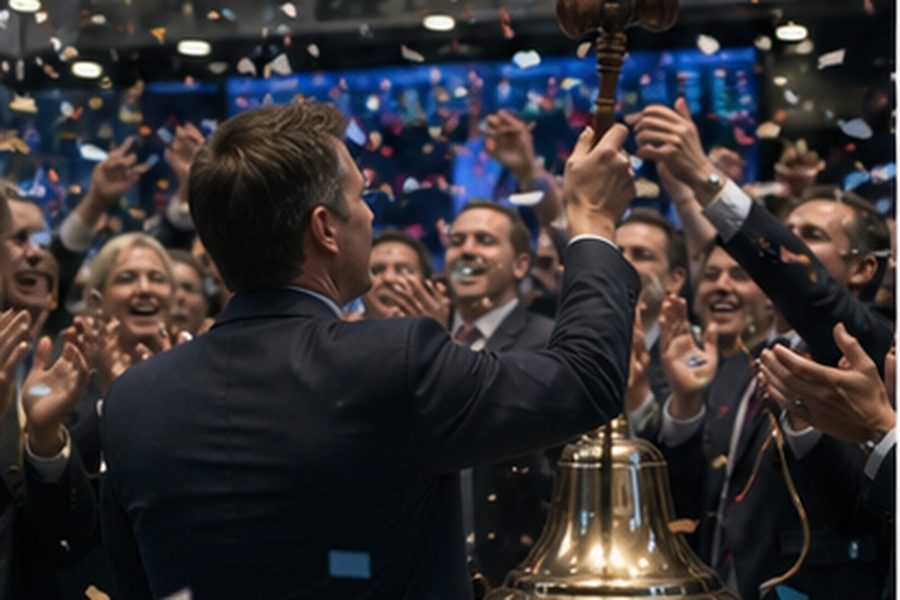
Anthropic is seeking a valuation of up to $1.4tn in its imminent stock market flotation, according to a US regulatory filing reported by The Guardian (theguardian.com). The Claude developer aims to raise up to $64.4bn by selling 825m shares priced at up to $78 each, a figure that falls short of the $2tn valuation widely expected before investors began to question the durability of the AI boom.
The filing sets a price range of $70 to $78 a share. At the upper bracket, The Guardian reports, Anthropic would be worth $1.4tn on a fully diluted basis, taking into account all common shares in existence including employee stock options. BBC News (bbc.co.uk) puts the implied range at between $1.1tn and $1.3tn, and says the company will list on New York's Nasdaq exchange under the symbol ANT on 19 November.
The structure of the raise
The headline equity sale is only part of the capital being assembled. The Guardian reports that Anthropic will raise a further $26bn through a separate private placement with cornerstone investors including Alphabet, the Google parent, and the chipmaker Nvidia. A greenshoe offering could add $9.7bn if investor demand is high, taking the total raised to approximately $100bn at the top of the price range. That total would exceed the $75bn raised by SpaceX, which The Guardian identifies as the largest ever stock market listing, at a valuation of $1.78tn. BBC News likewise places SpaceX at nearly $1.8tn following its June listing. On the equity raise alone, however, Anthropic's $64.4bn sits below SpaceX's figure. The founders are selling into the float. The Guardian reports that chief executive Dario Amodei is selling about $260m worth of shares, as are his six fellow co-founders, whose stakes would be worth more than $18bn each at the top of the range. BBC News notes that Anthropic was co-founded in 2021 by Dario and Daniela Amodei along with five others, all of whom previously worked at OpenAI.Revenue growth against a widening loss
The financial disclosures cut in two directions. The Guardian reports that Anthropic's annual revenue was running at $81bn as of 31 October, up $10bn from the previous month. BBC News, citing the company's most recent results for the six months to the end of June, reports that revenues jumped to $16.2bn from $1.1bn in the same period a year earlier, while the pre-tax loss widened to $80.7bn from $12.9bn. BBC News describes the company as loss-making. The cost base is dominated by computing power. According to the prospectus, as reported by The Guardian, Anthropic has compute purchase commitments and lease agreements of more than $70bn over the next 12 months, more than $450bn by 2030, and a further $450bn due by 2045. Those obligations explain why the revenue run-rate is the number investors will scrutinise most closely. Amodei has himself framed the risk in stark terms. In a podcast appearance earlier this year, he told podcaster Dwarkesh Patel: "I could buy $1tn of compute that starts at the end of 2027. If my revenue is not $1tn, if it's even $800bn, there's no force on Earth, there's no hedge on Earth, that could stop me from going bankrupt." The Guardian reports that Goldman Sachs, which is leading the float alongside Morgan Stanley, is forecasting annual revenues of $600bn by 2030, a figure first reported by the Financial Times.A cooler market
The reduced valuation reflects a change in investor mood rather than any revision to the company's own plans. The Guardian reports that investor jitters crystallised last week when US midterm elections produced victories for datacentre opponents, adding to existing concerns about how quickly companies can generate a return on AI infrastructure spending. Brian Hopkins, a principal analyst at Forrester Research, told The Guardian: "The market needed an excuse to correct itself a little bit in terms of valuations." He added: "The US election spook is what has caused it." Hopkins said Anthropic's valuation had been lowered from an anticipated $2tn as a consequence. BBC News reports that the Nasdaq fell sharply after the midterms on concerns that a Democrat-led Congress could slow AI development and datacentre buildout. Fiona Cincotta, a senior market analyst at City Index, told Reuters that the $64bn Anthropic wants to raise is "fairly bullish" within "the volatility [and] concerns towards AI that we've seen in sort of particularly last week". She added: "It's showing that they are still sort of upbeat about the outlook as far as AI is concerned and that obviously that they think that the demand is going to be there."Governance and the safety question
The listing comes with an unusual feature for a company of this size: Anthropic has warned publicly about the technology it sells. BBC News reports that the company said last month that AI could pose "catastrophic or existential risks to humanity", and that its filing admits advanced systems "could, if not developed, deployed, and operated with appropriate safeguards, oversight, and security measures, pose catastrophic or existential risks to humanity, particularly if such systems were misused, replicated, weaponised, or allowed to operate with a high degree of autonomy". The company has reiterated promises to develop AI to be beneficial to people, and has warned investors its future success depends largely on its ability to develop the most advanced AI models, and that "any failure to do so could adversely affect our business". BBC News notes that Anthropic will be the first fully AI-focused company to go public, making it a test case for the technology. It announced its intention to list in June, and OpenAI followed suit, with that listing now expected early next year. The Guardian also notes a Chinese spying scandal enveloping Nvidia, a cornerstone investor, which it says has so far affected only Nvidia's share price.Why It Matters
Anthropic's flotation is the first occasion on which public market investors can put a price on a pure-play frontier AI business. The disclosed revenue run-rate, the compute commitments running into hundreds of billions of dollars and the governance terms in the filing will together set the benchmark against which OpenAI and later AI listings are assessed. A successful float at $1.1tn to $1.4tn would support the view that enterprise AI demand is durable revenue rather than speculative enthusiasm; a weak reception would harden the scepticism that has already pulled the expected valuation down from $2tn.Commercial Impact
For founders and operators, the filing provides the most detailed public picture yet of the economics of a frontier model developer: rapid revenue growth, a widening loss, and contractual compute obligations that extend decades. Enterprise buyers negotiating with AI vendors now have a disclosed revenue figure to weigh. For investors, the private placement with Alphabet and Nvidia means a meaningful portion of the capital raised arrives outside the public book, concentrating the market test in the equity sale itself. Goldman Sachs' forecast of $600bn in annual revenue by 2030, reported by the Financial Times and cited by The Guardian, gives the market an explicit number to accept or reject.Risks and Unknowns
Trading is expected to begin next week, and the final valuation will depend on where the book closes within the $70 to $78 range. The greenshoe, worth up to $9.7bn, is contingent on demand. Beyond the float, the central uncertainty is the relationship between revenue growth and compute commitments: the prospectus figures imply obligations far above current revenue, and the company's own chief executive has described the consequences of a shortfall in unsparing terms. The political environment adds a second unknown, with midterm results having already shifted sentiment towards datacentre development. Whether the safety warnings in the filing affect institutional demand is untested.FY Outlook
The immediate signal will come from the pricing of the book and the first days of trading from 19 November. A listing at the top of the range would place Anthropic among the largest US tech debuts and give OpenAI a firm reference point for its own expected listing early next year. A listing at the bottom, or a weak aftermarket, would suggest that public investors are applying a discount to AI revenue that private backers have not. The revenue run-rate disclosed in future filings, and the pace at which compute commitments are drawn down, will be the measures that determine whether the $1.4tn figure looks prescient or optimistic.Sources and References
- The Guardian — theguardian.com, "Anthropic targets valuation of up to $1.4tn in stock market flotation"
- BBC News — bbc.co.uk, "Claude chatbot maker set for $1.3tn stock market debut despite 'catastrophic' AI warning"